
Uncategorized

Get to know Hendy’s new President – Jess Wilson!
Earlier in April, we announced that Jessica Wilson is taking over as Hendy’s President. Sarah and Jess sat down (thanks to zoom) to talk about Jess’s experiences and excitement about the transition. Read below to get to know more about Jess! And read her first team spotlight here.
Congratulations on your new role leading Hendy! I am so excited about you taking the reins and leading Hendy into the future. For folks who haven’t yet had the pleasure of meeting you, can you share a bit about your background and the experiences that led you to this role?
I’ve had the great pleasure of being a part of the Hendy team for almost 8 years, and have led client projects large and small across talent, academics and strategy. In my work, I’ve leveraged the skills and competencies that I hope will serve me well in the President role including strategic thinking, project management, communication, and change management. Even before my time at Hendy, I served in roles that required me to manage multiple priorities and projects at once, and to motivate groups large and small to take action on behalf of kids. Prior to coming to Hendy in fall 2017, I was the Executive Director of Talent Impact at Cleveland Metropolitan School District. There I led the implementation of all of our employee performance management systems, and managed our efforts in professional licensure and certification. Before CMSD, I served in various roles at TNTP where I worked with systems like Pittsburgh Public Schools, Newark Public Schools, and the Florida State Department of Education. I started my career in strategy consulting with community-based nonprofits. In addition to my “day job” I also serve as an elected member of my community’s public school Board of Education. Each of these jobs and roles has required me to use my skills and strengths, and has helped me to be ready for this new role. My biggest teaching experience so far? Parenting tweens. Nothing requires more patience and flexibility than living with an 11- and 13-year old.
Haha! Absolutely! What excites you about leading Hendy?
My favorite part about working with Hendy is partnering with such an exceptional team. Jeremy, Erica and Rachel are top in the field, and I learn so much from each of them in our work together. I’m excited and humbled to get to step into this leadership role to support these awesome people to thrive. And to keep doing so with you, Sarah, as Executive Advisor – you have a lot of wisdom to offer me and the field.
I’m also excited to explore ways to take our business into its next phase of life. I’m a systems thinker and systems builder, and I get really excited about protocols and processes (nerd alert). I’m looking forward to flexing those muscles as we explore ways to deepen our impact for clients and our sustainability long-term.
You’ve been a part of the Hendy team for a long time. What do you think makes Hendy special?
At the risk of repeating myself, we have the smartest and best people delivering support and solutions for our clients. But more than just support, we truly partner with the people we work with, and share their goals as our own. We are very nimble in our work, and are willing to collaborate with the organizations we serve to make sure they get the most out of our partnership.
I’m also very proud of the work we’ve done to build cohorts for leaders. We’ve made it a priority not just to engage in project work, but to create spaces for education leaders to come together to learn, share and grow. Our work with cohorts allows us to expand our impact and serve more leaders and more kids.
We build lasting relationships with clients. Some of our past clients have become good friends – and continue to do the great work that we built together. Working in education is not easy (and seems to be getting more and more difficult) – I appreciate the communities we’ve built with our clients, cohorts and coachees.
I couldn’t agree more. We all know that we’re in a challenging time in our country and in schools. What value do you think consultants can play to support education leaders in this particular moment?
There is so much happening in our world, and so much that is affecting or has the potential to affect the education sector at large. School system leaders must navigate threatened or real changes to their contexts while also meeting the needs of their students and staff – and keeping the lights on. One thing I’m so proud of in how we structure our consulting work is that we are true partners to our clients. Because of the way we structure our work, a Hendy consultant can serve not just as a support person, but as a thought-partner to leaders as they encounter changes or challenges in their environment. We can distill a lot of information to what is “need to know” for our clients and their context, and ask strategic questions that help clients to navigate their challenges and make strong decisions. And, we can be an empathetic ear. I once had a client tell me he appreciated our time together because he could “take off his cape”. In this moment especially, education leaders need safe space and relationships to let their guards down and process what is happening.
Thank you so much, Jess. I’m sure folks will be eager to connect with you and the Hendy team for support. How can people connect with you if they want to learn more?
Send me an email at jessicawilson@hendyavenue.com or click here to set up a call. I love chatting with people!
How We’re Striving to be an Anti-Racist Organization: Reflections from the 2020-2021 School Year
In June 2020, Hendy Avenue Consulting, like many other organizations, responded to the murder of George Floyd with a statement supporting the Black Lives Matter movement and condeming acts of racism. We felt it was important to make a statement, but knew that alone was not enough, so we also made a series of commitments:
“We commit to continuing our own growth and learning as individuals and as a team. We commit to elevating the voices of our colleagues of color. We commit to loudly speaking out against racism. We commit to deepening our understanding of how the human capital systems we help to design and implement can either support or hurt both staff and students of color. We commit to creating spaces for education leaders where they can bring their full selves and safely speak their truth.
As educators, we have a responsibility not just for reading, writing, and arithmetic. We have a responsibility to help shape a better tomorrow. Breaking down racism and white supremacy culture is not parallel to the work of education, it is the work.”
A year later, we reflect on the progress we’ve made and how far we still have to go to be an anti-racist organization, and to use our influence to create anti-racist spaces and tools and to develop leaders who promote diversity, equity, and inclusion. We share our reflections both to hold ourselves accountable as well as to share how even a small organization such as ours can make strides toward equity. Over the past year, our team has made improvements in: what we measure, who we work with, what we do, and how we grow.
- What we measure:
- Hendy Performance Rubric: We first updated our Hendy organization and individual team member performance rubrics to reflect our equity goals, giving ourselves a north star from which to develop our anti-racist organizational strategy.
- Hendy Performance Rubric: We first updated our Hendy organization and individual team member performance rubrics to reflect our equity goals, giving ourselves a north star from which to develop our anti-racist organizational strategy.
- Who we work with:
- Consulting Partners: We’ve partnered with several consultants who are BIPOC educators, consultants, and coaches and are making it a priority to continue to do so in the future. A few fantastic BIPOC partners to shout out for their excellent work: Keri Hubbard (now an incredible member of the Hendy team!), Ashley Griffin at BEE Consulting, Carrie Ellis at Celestial Consulting, Precious Boyle at Silent Rock, Audrey Lane and LaTisha Vaughn at E3 Management, and Mike Montoya and Luis Rodriguez at Stronger Consulting.
- Cohort Members: We also prioritized engaging leaders of color in our Spring 2020 Addressing Learning Gaps Cohorts and our 2021-2022 Chief Academic Officer Cohort and seek to create learning spaces where participants can bring their whole selves to the group.
- What we do:
- Observation Rubric Workshops: We recognized that one of our most direct influences on diversity, equity, and inclusion is in teacher observation and feedback rubrics and invested in our own learning in this area. Looking ahead, we are committed to providing support to others around revising their rubric language. More information on that opportunity coming soon!
- Observation Rubric Development: The team, in partnership with our clients, has been responsible for writing observation and feedback rubrics for the Delaware Department of Education and for KIPP Texas Public Schools. Both of these rubrics take a strong equity and inclusion stance and will advance equity in their classrooms.
- Academics: Our team has an increasing focus on academics and is bringing an anti-racist lens to our academic work, particularly in mathematics where student expectations, opportunities, and instructional methods too often hold back kids of color.
- Strategic Planning: We are partnering with one charter network to create DEI strategic plans for each of their schools following unfavorable survey feedback from teachers.
- Talent: We continued to have an equity focus in our examination of and revision to teacher compensation systems. We also focused on equity throughout our development of a Talent Toolkit for Chicago Public School administrators. For example, one PD session within the CPS Talent Toolkit focused on how to effectively lead their evaluation system and included IRRPP research to train principals on how to build trust across lines of difference.
- Cohort Content: Our cohort facilitators prioritized a focus on diversity, equity, and inclusion as an on-going theme in our Chief Talent Officer Cohort and Addressing Learning Gaps Cohorts.
- How we grow:
- Individual Professional Learning Goals: Each member of our team now includes explicit goals related to DEI knowledge-building and influence in our individual professional learning goals.
- Accountability and Reflection: To ensure that our individual growth doesn’t get pushed aside, our team discusses progress toward our individual DEI goals every 6-8 weeks.
- Consultancy: We regularly problem-solve together as a team when we face equity challenges in our work and, when needed, we reach out to experts in the field to get specialized guidance on how to support or challenge our clients.
Looking Ahead
As the founder of Hendy, I’m proud of how much we’ve done over the past year to become a more anti-racist organization. I have no illusions that our equity work is done or ever will be, however, I do believe we’ve set a foundation for our future work that will serve our team and our partners well. I also believe we’ve built momentum that will propel us forward, each year getting smarter and having a greater influence. A few specific goals for the 2021-2022 school year include:
- Reviewing and refining our language in our performance rubric and partner survey.
- Continuing to grow our partnerships with BIPOC educators – not just with other consultants, but also with the clients with whom we choose to work.
- Leading strong observation and feedback reviews such that observation rubrics are driving teachers and administrators toward behaviors that enhance equity and inclusion in classrooms and schools.
- Centering our CAO Cohort around equity to ensure that all students are getting the educational opportunities they need to be successful.
- Revising our consulting contract language and our launch meetings to make clear our anti-racist stance and what that means for our partnerships.
- Reflecting on the ways in which our internal practices are based in a white supremacy culture and may not be serving our team or clients well and making necessary changes.
- Continuing our individual equity goals, regular team reflections, and team problem-solving so that we can provide better support to our partners and can support/push their thinking and decisions.
If you have any feedback on our work so far, or our goals for the upcoming year, please let me know. We’d love to learn from and with you!
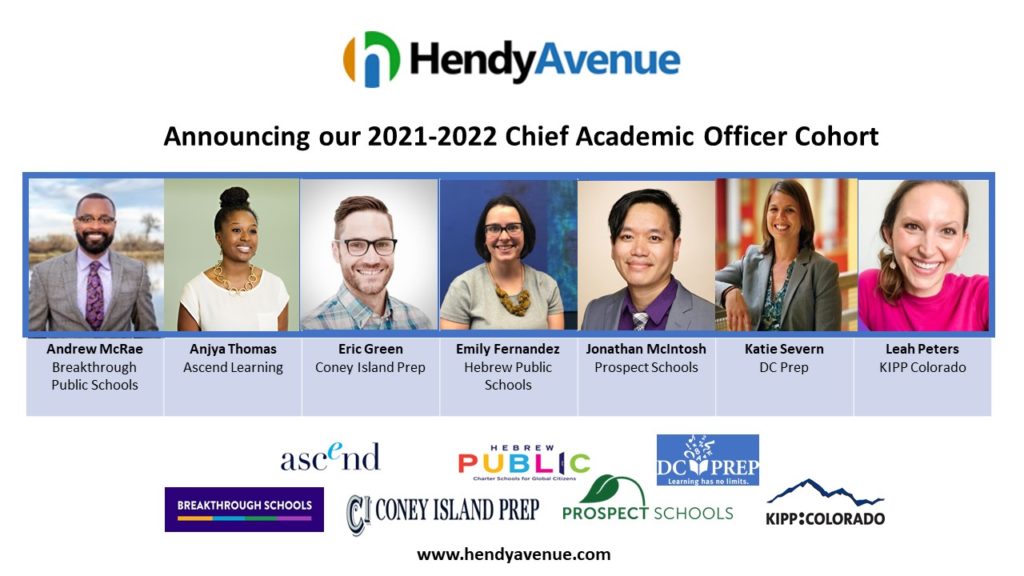
Announcing our 2021-2022 Chief Academic Officer Cohort
We believe leaders need other leaders. Learning alongside trusted colleagues in similar roles, leaders sharpen their vision, build their skills, exchange resources, problem solve, build relationships, and feel more fulfilled in their work. Building on the successes of our other cohorts and with the generous support of the Charter School Growth Fund, Hendy is proud to introduce our inaugural Chief Academic Officer Cohort.
The 2021-2022 Chief Academic Officer Cohort members are:
- Andrew McRae – Breakthrough Schools
- Anjya Thomas – Ascend Learning
- Eric Green – Coney Island Prep
- Emily Fernandez – Hebrew Public Schools
- Jonathan McIntosh – Prospect Schools
- Katie Severn – DC Prep
- Leah Peters – KIPP Colorado
These incredible leaders have a shared commitment to working together to solve common challenges and creating more equitable opportunities for all children. Cohort members will come together for virtual monthly cohort sessions led by Hendy’s expert facilitators, who themselves have been C-level executives in high performing charter school networks. This program is unique in that it is responsive to member needs, builds lasting relationships, provides both immediately helpful resources as well as long-term, philosophical considerations, builds leader skill as team leaders and senior organization leaders, integrates the roles of talent in academics, and includes a commitment to distributing our learning to benefit a broader audience outside of the cohort (stay tuned!). Our first session is in September and we can’t wait to get started!

On the Air: Jess Talks Rubrics with EdPOP
School leaders are busy people; we know from experience that it can be really tough to keep up on the latest trends and research when you’re in the trenches every day. We also know that being a school leader can be isolating sometimes. It’s rare that a leader gets to step out of his or her building and see what’s happening in other schools. That’s why we are so excited about the new podcast EdPOP: Education Problems of Practice. The podcast, hosted by educators, provides leaders the opportunity to get a glimpse into other schools; to learn about the latest in K-12 education; and to hear from experts – all in an easy-to-digest podcast. Educators can even earn continuing education hours for listening.
We are especially excited about the most recent episode, released today – find the full episode here or the specific segment is S1E3 Chapter 3: Journal Club. Our own Jessica Wilson was interviewed about her experiences with teacher observation rubrics, and recommendations for leaders. Teacher observation is an issue near and dear to our entire team’s hearts, and we are excited to have had the opportunity to share our experiences with others. Take a listen, and let us know what you think!

Make Your Pick: How the NFL Draft Applies to Teacher Hiring
While there is a lot of best practice research out there about how to hire a great team, leaders seeking teacher talent can take a cue from how professional sports teams scope out and draft players. In the post below, we bring Cade Massey’s article on 5 lessons we can learn from the NFL draft into the world of teacher hiring.
1. Know what you need. Before you even begin to recruit teachers, be clear on what type of teacher you need for your school. Of course, certification, grade and subject-area matches matter, but identifying a great fit requires more. Assess your current staff to identify where your team has strengths, and where there are gaps. Perhaps you need a teacher with great data skills who can support your team’s efforts to review and act on student outcomes. Or perhaps you need a teacher who can effectively implement writing across the curriculum. Also consider your strengths as a leader; do you have capacity to coach a novice teacher? Or do you need someone with more experience? Being clear about the ideal profile of a candidate can help ensure that you focus your limited resources on a hiring process that will yield the best outcome.
2. Get input from others. While the school leader is often the driver and decision-maker when it comes to hiring, ensuring that teachers, other leaders, and even parents are engaged in selection will help ensure that the best candidate is chosen for the school. Consider a process that allows you to solicit input and ideas from a variety of stakeholders. Allow each stakeholder to have an independent review of finalists, and to form their own perspective about fit. One easy way to engage multiple stakeholders quickly is to use a panel interview, or to have multiple stakeholders act as students in a demo lesson (see item 3).
3. Understand the candidate from multiple angles. Resume reviews and interviews are a great first step in getting to know a teacher candidate. But, often that isn’t enough. As football scouts actually see candidates play, getting a glimpse of your top candidates teaching will help you understand how they may fit into your school culture. Request a video of the candidate teaching, or request that they teach a demo lesson in your school or with your selection committee. Even observing 10 minutes of teaching can help you get a full picture of the candidate’s skills and growth areas.
4. Be consistent in your selection model. Hiring is about assessing people, which can be a messy business. No matter how disciplined we are, our opinions of others are naturally informed by the biases we carry; we’re all human after all. As you design your selection approach, consider a rubric and scoring mechanism that makes considering multiple variables factors more formulaic. Bringing order and data to a process like hiring can help ensure that factors like selection bias do not play a significant role in who is selected for your school.
5. Keep score and reevaluate. The only way to know if your selection process worked is to map it against results. Once you’ve selected your dream candidate(s), keep a record of the selection process and the factors that led to their hire. Then, after their first year, compare the teacher’s results to your selection. How accurate was your assessment of their strengths and growth areas? Did your selection approach yield a candidate that made gains with students? If so, what should you replicate? If not, what might you tweak for future hiring?
Sound off in the comments: What lessons have you learned from teacher hiring? What strategies have been most useful in identifying your best candidates?
Designing Evaluation Frameworks with Development at the Core – Part II: Raising Rubric Rigor
This post is the second in a series on how innovators are reimagining the design and implementation of evaluation and development frameworks. To read our first post in the series, on the impact of frequent observations, click here.

Most teacher evaluation systems today include direct observations of teacher practice by an administrator, in which the administrator determines ratings by assessing what they observed against a common performance rubric. It is challenging to capture the complexity of teaching in a single document, however strong rubrics have the capacity to set clear expectations, establish a common language, and chart a course for development over time.
During our work with school systems across the country, we have seen a few common challenges with widely-used rubrics:
1. Structure: Rubrics can be too long, wordy, and easy to master.
When rubrics are too lengthy, they can be overwhelming or intimidating to educators, fail to prioritize high-leverage teacher actions over lower-impact strategies, take too long for observers to complete and are challenging to norm across multiple raters. Additionally, when rubrics are too “easy”–that is when basic instruction with minimal impact on student learning aligns to language at the highest levels–we rob educators of a true pathway for growth in their careers and limit their potential for excellence.
2. Framing: Rubrics generally focus only on teachers.
When rubrics describe only what teachers are doing and saying they fail to take into account what matters most: the impact of instruction on students. This can limit the value of observation feedback and lead to misalignment between observation ratings and other components of an evaluation framework.
3. Content: Rubrics are often not aligned to today’s raised academic expectations.
When rubrics do not call for rigorous instruction aligned to core content standards (Common Core, Next Generation Science, etc.) they miss the opportunity to set expectations for learning at the appropriate bar. Similarly, as our knowledge of social-emotional learning, cultural competency, and technology expand, many rubrics have yet to adapt and account for new knowledge and skills.
In the face of these challenges, innovators are creating a new normal for observation rubrics. Through our partnership with school systems across the country, we have seen that there is no one right way or perfect rubric. Rather, systems need to consider their unique culture, expectations, observer skill level and existing structures to find or develop a rubric that will work best for them.
DREAM Charter School: DREAM prioritized finding a streamlined observation rubric that would be appropriately rigorous as teacher advances along their career while less cumbersome than the tool they had previously been using. Following research into available tools and piloting of a select few, DREAM identified the TNTP Core Teaching Rubric as the right resource: it was aligned to academic content standards, written in the form of student outcomes, and best of all, was only four pages long! DREAM revised some language to incorporate school-specific competencies that drive their unique student and adult culture. Following the first year of implementation, nearly 80% of teachers said the rubric defines excellent instruction well.
KIPP Houston Public Schools: The original and largest KIPP region is currently piloting the Reach to Rigor rubric, a new tool created in-house that defines academic and cultural expectations for teachers and students. The rubric is broken down into four parts with only the most critical components of great instruction included. The rubric language also includes both teacher and student actions, to ensure that instructional moves by the teacher are only deemed high-quality if they have the desired effect on student thinking and behavior.
Achievement First: One of the first movers in formalizing a career pathway for teachers, Achievement First has refined their approach to observation and feedback over time. The network developed and launched an updated AF Essentials Rubric that was intentionally designed to be concise, clear, focused on student actions. The rubric is aligned to the Common Core and expectations of Advanced Placement courses, shifting more emphasis to intellectual rigor and deep student thinking. The rubric includes both “foundational” (e.g., tight classroom or kids on task) and excellence (e.g., investment and deep student thinking) criteria.
What are other innovations in observation rubrics? Add your ideas and/or experiences in the comments section below.